

The best way to control your story in the age of AI is to tell it completely.
The Discovery
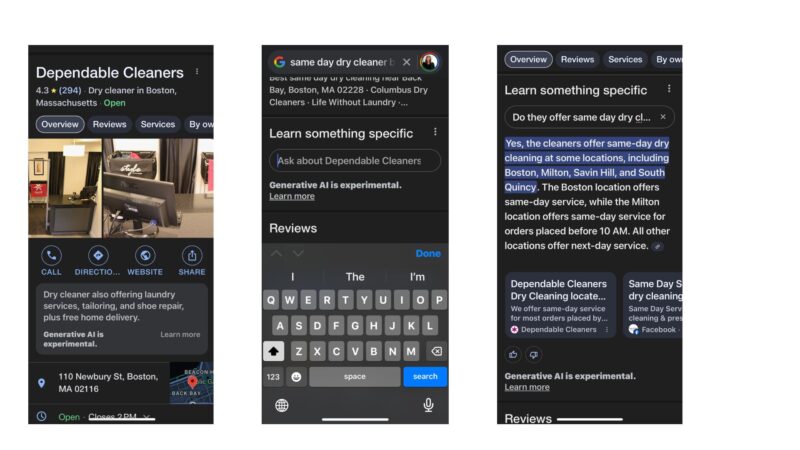
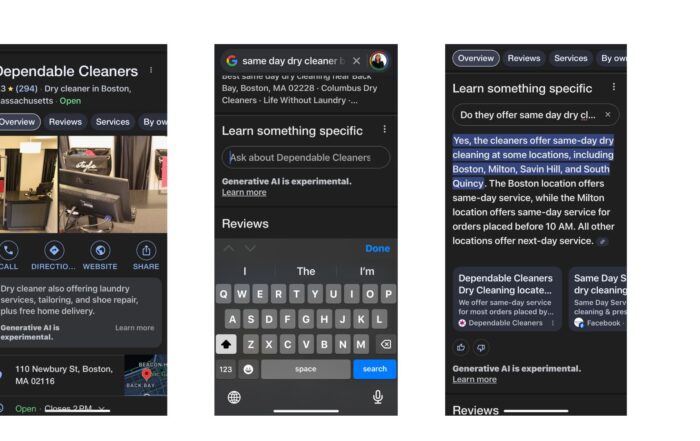
Recently, while traveling, I searched for a dry cleaner with same-day service. In my search results, I noticed a game-changing shift. Google offered me the option to “Learn Something Specific” about the dry cleaner I selected from inside local search results.
I could ask detailed questions about the business, and Google’s AI would answer. I could ask about same-day service options, pricing, and locations – all without ever leaving their Google Business Profile in local search.
Google pulled answers tailored to my specific needs directly from the business’s website and social media pages for me.
Why This Is Different
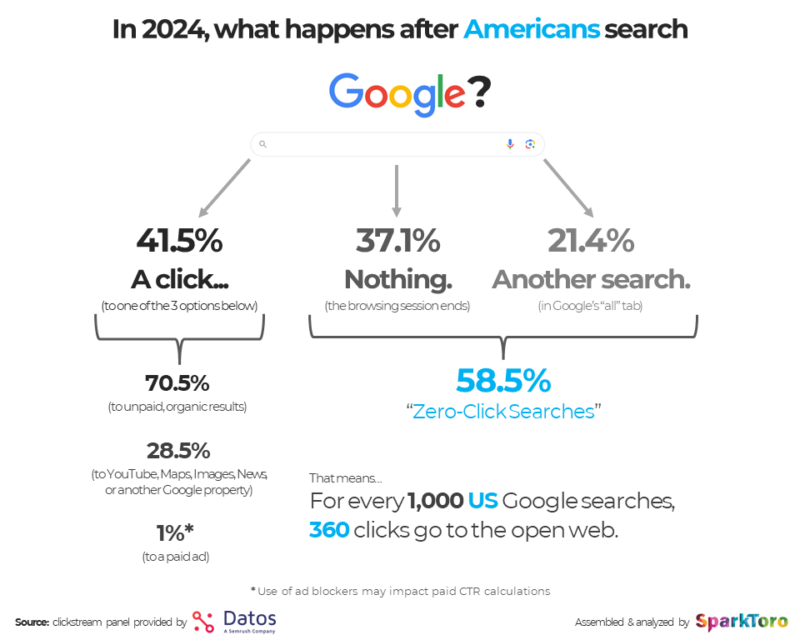
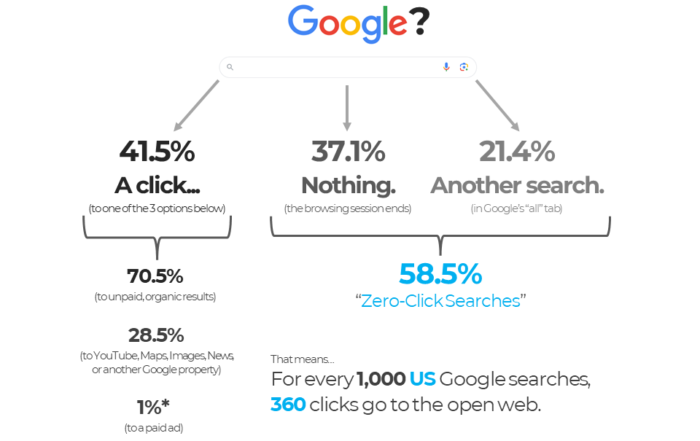
We have seen zero-click searches for some time. In fact, a recent study by Rand Fishkin at Spark Toro found that over half of Google searches result in zero-click searches.
Some examples of zero-click search results you might recognize are Google’s knowledge panel answers, People Also Ask, People Also Search, and People Search Next prompts inside Google search results.
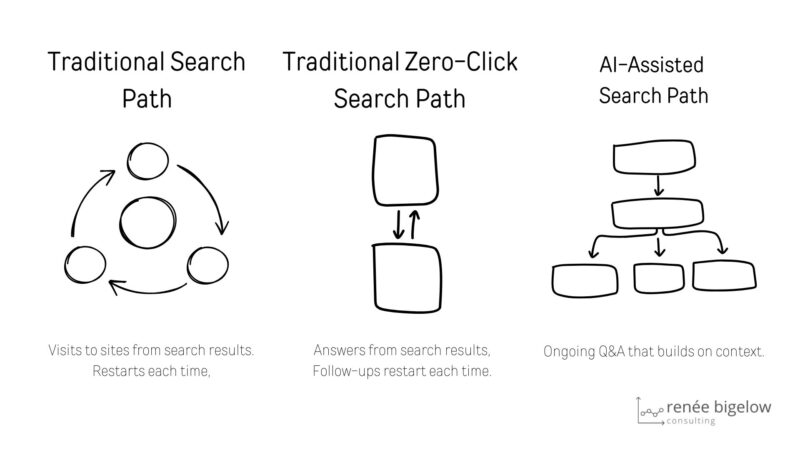
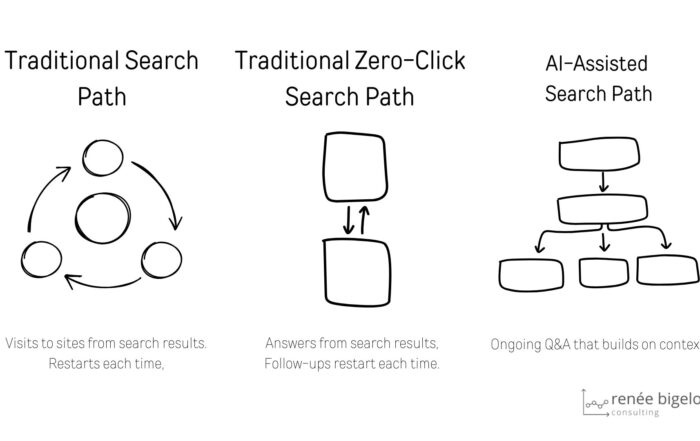
However, until this new AI evolution from Google, those searches “restarted” the journey with each query. Looking at this same study, you can see that 21% went directly to another search, restarting the journey. That doesn’t include the additional search volume that searched, clicked a site, but then went back to Google for more information.
This new AI-powered version, as seen in the screenshots I shared, gets the user closer to the answers to their questions. It takes them further down the buyer journey by answering more detailed questions about a specific business vs. restarting the journey from scratch each time.
When a user restarts, their question could send them down any one of several paths, but when the user can ask continuing follow-up questions, they can keep going further down the same path.
We’ve evolved from trying to guess the right keywords to simply asking questions in natural language. But for AI to craft accurate, helpful answers to these questions, it needs comprehensive, well-structured content to draw from. Without that foundation, AI either can’t answer or risks providing incomplete or incorrect information.
AI experts often emphasize that these evolving search experiences are powered by multi-turn conversations within AI models—meaning they retain context and keep building on previous queries. While we won’t dive deep into the inner workings of large language models here, it’s important to note that the more structured and complete the information you provide, the more accurate these AI-driven answers become.
The Reality Now
This isn’t future tech. This is happening right now. However, to be sure much more is coming and coming quickly. These changes are already impacting how your potential customers find and evaluate businesses. Your buyers are already having these AI-assisted conversations about your brand and products/services – whether you are prepared for them or not.
Businesses that don’t act risk falling behind competitors who are already positioning themselves as the go-to source for AI-assisted queries.
The Evidence
The numbers prove I am not alone in using AI as a research assistant. Despite imperfect attribution tracking methods for this nascent channel, websites are starting to see the impact.
According to the latest research from Ahrefs, 63% of Websites Receive AI Traffic. The percent of traffic coming from AI is tiny at less than 1%, but it is growing (reminder: the tracking on this traffic is imperfect, likely meaning that the true percent is higher.) Some industries like B2B and technology are seeing much higher percentages. One especially important thread from many marketers shows that this traffic is of higher quality and more likely to convert.
Another metric proving the growing significance to marketers and brands is how many search queries generate AI overviews on Google Search – not the chatbots.
As of January 2025, Google’s AI overviews appear in 30% of searches and nearly three-quarters of problem-solving queries and this number is expected to grow.
In Google’s Q4 2024 Earnings Call, CEO Sundar Pichai said:
“People use Search more with AI Overviews and usage growth increases over time as people learn that they can ask new types of questions. This behavior is even more pronounced with younger users, who really appreciate the speed and efficiency of this new format. As AI continues to expand the universe of queries that people can ask, 2025 is going to be one of the biggest years for Search innovation yet.”
“Those numbers are growing fast as product features and capabilities are added to AI models and user adoption grows. It signals a significant shift in how people are finding and evaluating businesses and products/services.”
The Bigger Picture
AI is quickly becoming a research assistant in the buyer’s journey. It helps people gather and organize information in a hyper-personalized way. One of the most distinguishing differences between AI and traditional discovery and research methods is that AI can continue assisting a buyer with back-and-forth Q&A that we might typically consider a part of the sales process.
It mirrors how people naturally research purchases: gathering information from multiple sources, comparing options against their own set of criteria, and narrowing choices before making direct contact.
Over the last decade, the percentage of the buyer’s journey that buyers take before ever talking to sales has grown to 70%. All of this without factoring AI into the journey.
This shift reaffirms the importance of addressing content gaps for marketers and SEO practitioners. By mining unstructured data (like call transcripts or chat logs) for frequent buyer questions and publishing well-structured answers, you not only serve human visitors but also feed AI the accurate, detailed information it needs to guide buyers further along the journey without missing key details.
What we are seeing is not a revolution from buyers. It’s an evolution of an increasingly buyer-driven market, where buyers have long preferred to conduct their own extensive research before engaging with brands or sales. AI is simply the newest tool, making this research process more efficient and comprehensive.
But this evolution will likely pick up speed and traction this year as adoption grows and AI agents can further automate the research process.
How Do We Prepare for AI Answer Optimization and AI-Assisted Research?
One of the mantras I have been repeating with clients about changes in marketing due to AI is that we must be far more explicit with our buyers and publish that information online, where they can access it freely and where AI bots or agents can scrape it.
In many cases, we have limited information in the past because of a desire not to overwhelm our customers. Even when making the best choices, we always left gaps and unanswered questions for our buyers.
Now that AI can assist them in filling those gaps, it is critical that we ensure that AI has exhaustive, factually correct sourcing to pull from when asked about our brand, products, or services.
While there is always the chance that AI could make mistakes in delivering or synthesizing the information we publish, the probability of incorrect information or hallucinations increases exponentially if we don’t publish anything or publish incomplete data.
An AI bot or agent has a mission to provide answers or gather information based on the user’s criteria. That mission will be accomplished somewhere if we don’t provide it. Where it can’t verify, it may go to other sources, or it may guess.
Conversely, if we provide more information than our competitors and make it easier to access, we may benefit competitively by becoming the trusted source that AI quotes to our buyers.
In other words, the best way to control your story in the age of AI is to tell it completely.
Turn your unstructured tribal knowledge into structured buying power with the help of AI.
Two key insights I’ve gained from experimenting with AI for marketing:
First, it excels at helping us make sense of previously unmanageable unstructured data inside our organizations (like call recordings and meeting notes).
Second, it provides more accurate, reliable answers when working with well-structured data sources.
Further, from a sales perspective, this also means fewer surprises when prospects reach out. If your AI-surfaced content addresses common objections upfront, buyers enter the sales conversation with clearer expectations—improving close rates and speeding up deal velocity.
Where to Start?
When there is a seismic shift in information gathering that can impact the buyer’s journey, it is easy to feel overwhelmed as a marketer. Especially when there is no roadmap to success, and the path is very foggy.
As we think through finding unstructured data to structure and making that structured data more easily accessible, we can look at our existing toolkit for lower risk and higher value opportunities.
The sweet spot is lower-risk, higher-value opportunities that help build a foundation for an AI-assisted journey of the future. Jumping into more sophisticated attempts before we have that foundation is frustrating and expensive and often causes initial failures. Advanced AI initiatives frequently lead to confusion, wasted resources, and lackluster results without a solid structured database.
In this post, I provide one particularly low-risk/high-value opportunity on websites I am implementing with clients and give several examples of how it can be used. I believe it is one of the best foundation-building activities for structured content on sites. Going through this playbook will help you think of even more low-risk/high-value opportunities in the sweet spot.
As you implement these structured content tactics, you’ll also lay the groundwork for advanced AI strategies—like using chatbots or AI agents to carry on multi-step, personalized conversations with your buyers. By consistently transforming unstructured data (like call recordings) into structured knowledge (like FAQ posts or product specs), you ensure that any AI tool you adopt has an accurate, robust information base to draw from.
Finding Solutions in The Existing MarTech Stack
SEO is one of our first experiences with AI and bots. Much of what we as marketers have built around the discipline of SEO prepares us for AI-assisted research.
I mentioned earlier that we have to tell our story completely in the world of AI-assisted research. As I started building out my vision for the low-risk/high-value opportunities, I started a mental checklist of the criteria we know now that could impact our discoverability:
My requirements:
- One Place/Method a bot could easily scrape information quickly and efficiently without triggering Google search penalties for hidden content or other black hat SEO tactics.
- Since that information was just as helpful for human users, how could we make it digestible without publishing it twice – which could trigger duplicate content penalties from Google?
Knowing this, I enlisted help thinking through what tools we already have that could be used differently. I reached out to my friend Noah Learner, who runs the SEO Community and frequently speaks at conferences about data in SEO and marketing. Noah helped me think through some of the top tools in the current marketing tech stack.
We focused on the underlying information architecture in websites already used to assist bots – tools like sitemaps, schema, and folders. Since WordPress is one of the most ubiquitous website platforms for mid-size companies, we concentrated on it first as a tool many marketers already use.
After discussing my examples and various use cases, Noah suggested custom post types in WordPress. WordPress already uses posts and archives in its information architecture – the foundation for blog posts and blog feeds. Custom post types let you use the same functionality, including taxonomies for categories and tags, which give you easy ways to organize content feeds outside of a blog.
FAQs On Steroids As A Solid Foundation for AI Answers
The example from the Google search results for the dry cleaner I shared proved that these projects need to be prioritized in early 2025.
My first use case was FAQs. Many businesses list 20-50 curated questions and answers on their website. Above that, the list becomes overwhelming unless there’s great UX to help users navigate to relevant questions.
However, we already know that users have tons of questions, and we have recorded them in multiple sources of unstructured data throughout an organization. We also know that in a chat interface where customers can ask questions about specific products and services, FAQs play a outweighed role in quickly surfacing the information that buyers need.
Custom Post Types could help me put FAQs on steroids on my clients’ websites.
Here’s how I implemented the first phase of the project:
- Created a custom post type for FAQs with categories for each service line
- Embedded the archive feed for each category on corresponding service pages and related blog posts
- Established an ongoing maintenance process:
- Upload sales calls and team meeting recordings to AI
- AI identifies new FAQs and suggests categorization
- Team members edit AI-drafted FAQs that include the words our customers use
- New FAQs are added to WordPress (about 2 minutes per entry)
- Content dynamically appears where relevant
- Edits are made in one place on the FAQ Post, which updates dynamically throughout the site.
NOTE: I know my way around WordPress, but I am NOT a developer. Yet, I could do all of this (with a bit of help from my friend ChatGPT) on an unfamiliar new client website as a pilot without hiring any additional developer work. I did this to prove that an internal marketing team could accomplish this without significant expense when given my strategy and playbook and a little time.
Making Menus Work for Everyone: A Restaurant Example
One of my favorite examples to illustrate better information accessibility is the restaurant industry. As someone with a food allergy, I frequently skip buzz-worthy restaurants simply because I can’t easily determine if they can accommodate my dietary restrictions safely and deliciously.
This isn’t a niche issue—nearly everyone knows someone with a dietary restriction (allergies, religious requirements, lifestyle choices, or health concerns). Restaurants make it more complicated than it needs to be for these groups to decide where to eat.
I share this example not because I work with restaurants but because its universality helps people think differently about their own information architecture. When I explain how restaurants could structure their menu data this way, people immediately understand both the problem and the solution – and often start seeing similar opportunities in their own businesses.
Restaurants can dramatically improve this experience by making comprehensive ingredient information readily available when consumers are deciding where to dine. Using the same WordPress custom post type approach we discussed with FAQs, restaurants could create a structured menu system where:
Each menu item appears initially with just the basics – name, brief description, and price – maintaining a clean, traditional menu appearance. But each item can be expanded to reveal:
- Full ingredient list
- Preparation notes
- Modification options
- Nutritional information
- Photos
The menu structure uses categories for:
- Course type (Appetizers, Entrees, Sides, Desserts, Beverages)
- Meal service (Breakfast, Lunch, Dinner, Happy Hour, Brunch)
And tags for:
- Dietary restrictions (Gluten-Free, Dairy-Free, Vegan, Vegetarian, etc.)
- Individual ingredients for allergen identification
Each item can also include personal notes from the chef about inspiration or preparation, as well as relevant customer reviews mentioning specific dishes. This mirrors how people already research restaurants extensively before dining, making the process far more efficient and informative.
For human users browsing the website, they see a clean menu interface with the ability to access detailed information as needed. Meanwhile, AI can access the complete menu database to answer detailed questions about ingredients, dietary restrictions, or meal options.
Imagine how much this improves the dining experience before guests even set foot in the restaurant. Once they arrive, no one has to feel embarrassed about asking detailed questions about dietary restrictions, the ordering process is streamlined, and diners feel excited about their choices rather than anxious about potential issues.
Reducing Complexity in Technical Information For Full Customer Lifecycle Support
While restaurants offer a relatable example, manufacturers of complex equipment and solutions face an even greater challenge in making technical information accessible and useful. The stakes are also higher – getting the wrong menu item might ruin dinner, but choosing the wrong equipment can impact an entire operation.
Manufacturers typically have extensive technical documentation, but it’s often scattered across various formats and locations: PDFs, internal databases, knowledge bases, and even individual engineers’ expertise. Manufacturers can organize this information using the same structured approach we discussed earlier to serve both buying decisions and ongoing customer success.
Here’s how the same custom post type approach can work for technical documentation:
Each technical specification could include:
- Basic product overview
- Detailed performance metrics
- Operating requirements
- Compatibility specifications
- Installation parameters
- Integration requirements
- Certification and compliance data
The information architecture could use categories for:
- Product lines
- Application types
- Industry solutions
- Technical domains
And tags for:
- Performance criteria
- Compliance standards
- Implementation requirements
This structure allows different stakeholders to access information that serves their specific needs. Technical buyers can dive deep into specifications and compatibility requirements. Implementation teams can access detailed installation guides. Support teams can quickly find technical details for troubleshooting. Account managers can easily reference expansion opportunities based on compatibility with existing installations.
Information can be presented contextually appropriately for human users browsing the website – from high-level overviews to detailed technical specifications. Meanwhile, AI can access the complete technical database to answer specific questions about compatibility, requirements, or implementation considerations.
The impact extends far beyond the initial purchase decision. When customers can easily access comprehensive technical information:
- Implementation teams start with better preparation
- Support interactions become more efficient
- Customers can self-serve many technical questions
- Account managers can identify expansion opportunities more easily
- Customer success teams can better guide adoption and utilization
This example demonstrates how making information more explicit and accessible prepares for AI and better serves human decision-makers and users at every stage. When we structure our information to be more comprehensive and accessible, we create value throughout the customer lifecycle while simultaneously preparing for the growing role of AI in business research and decision-making.
Another added benefit for the marketing, sales, customer service, and support teams is that this essentially creates a master database that is easier to maintain over time as well. This is another example of how this low-risk/high-value opportunity is staring us in the face right now, not just for future AI.
Practical Next Steps That Build on Your AI Answer Foundation
Making your information more explicit and accessible for humans and AI might seem daunting, but the change isn’t as complex as you might think. The tools you need are often already in your marketing technology stack – they just need to be used differently.
The custom post types example we explored is just the foundation for the FAQ project for a technology client. From there, we will surface this structured information in multiple ways:
- Contextual placement across the client’s digital presence
- Using the FAQs to help us script short video shorts and social media posts
- Develop webinar content building on grouped topics
- Create in-depth blog posts expanding on common themes
- Build out automated marketing email nurture campaigns
- Enriching Directory listings like Google Business Profile
- Creating more sales enablement materials
- Developing new customer support resources
Start small:
- Audit one key product or service area that can serve as your answer engine foundation
- Use existing tools to make current content more accessible
- Convert your team’s internal knowledge into buyer resources
- Implement quick wins while building comprehensive resources
- Measure improvements in buyer readiness and sales velocity
- Expand successful approaches to other areas
Preparing for the Next Evolution in AI Buyer Journey Disruption
As AI becomes more conversational and context-aware, these foundational changes—turning unstructured data into structured, buyer-facing content—set you up for more advanced possibilities. Whether you’re a mid-sized business starting with small FAQ updates or an enterprise looking to launch your own custom AI agents, the same principle applies: comprehensive, accurate data feeds better AI experiences. Sales leaders benefit from fewer buyer objections, marketers see improved engagement through AI-friendly content, and those building next-generation AI solutions gain a reliable knowledge base to power multi-turn conversations.
We’re already seeing the impact of AI in search results. Soon, AI agents will help buyers research and evaluate solutions more extensively. Companies that have built strong information foundations will:
- Be more discoverable in AI-assisted research
- Provide more accurate information to AI queries
- Adapt faster to new AI capabilities
- Maintain competitive advantage as buyer behavior evolves
The key is to start now: prioritize the right projects and use existing tools to build solutions that meet both current needs and future opportunities.
Inspired but still confused?
Adapting to these shifts can be daunting for mid-sized companies without the right expertise or resources. A Fractional CMO can help bridge the gap by developing strategies, leveraging existing tools, and empowering teams to thrive in this new era of AI-driven buyer behavior.
About the Author: Renee Bigelow

Continue Reading
How to Begin Future-Proofing Your Business for AI-Driven Buyer Behavior
The best way to control your story in the age of AI is to tell it completely. The Discovery Recently, while traveling, I searched for a dry cleaner with same-day service. In my search results, [...]

The Holistic Marketer Mindset
Empowering Marketing as an Organizational Catalyst. I was recently called a “marketing nerd” by another marketer, no less. I enthusiastically accepted the label, and we laughed. But then we talked about why he sees [...]
Let Me Show You What I Mean.
How many times a day do you say, “Let me show you what I mean?” Do you use it when trying to explain something complex to a team member? Or when trying to explain to [...]